Kid robot gets makeover
2:54 PM
The iCub robot, developed by a consortium of Europe unversities, is undergoing a makeover that will make it look more like a child. The robot is meant to test theories about how human children think, learn and develop.
The iCub is modelled on a two year old. However, earlier its hands were the size of an 8 year olds. This is because it was hard to make fully functional mechanical hands smaller. Now the hands have been made to look like those of 18 months old. The robot is also set to get a new pair of legs, which are lighter and more agile. This has been don to ensure the robot is healthy enough to handle injuries that would normally not bother a human child, but would damage a robot. The new designs will enable human to be around .
Portrayer robot !!
10:58 AM
This robot draws portraits, elaborating photos and images.
The software on the PC is developed under MATLAB®, following the ideas of Claude Baumann and his students at http://www.restena.lu/convict/Jeunes/... (Erik's XY plotter).
The hardware is LEGO MINDSTORMS NXT® and a soft tip pen.
Made by Daniele Benedettelli in 2008. More details at http://robotics.benedettelli.com
About- Swarm Bots
11:16 AM
Swarm robotics is a new approach to the coordination of multirobot systems which consist of large numbers of mostly simple physical robots. It is supposed that a desired collective behavior emerges from the interactions between the robots and interactions of robots with the environment. This approach emerged on the field of artificial swarm intelligence, as well as the biological studies of insects, ants and other fields in nature, where swarm behaviour occurs.
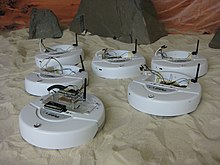
Both miniaturization and cost are key-factors in swarm robotics. These are the constraints in building large groups of robotics; therefore the simplicity of the individual team member should be emphasized. This should motivate a swarm-intelligent approach to achieve meaningful behavior at swarm-level, instead of the individual level.
Potential applications for swarm robotics include tasks that demand for miniaturization (nanorobotics, microbotics), like distributed sensing tasks in micromachinery or the human body. On the other hand swarm robotics can be suited to tasks that demand cheap designs, for instance mining tasks or agricultural foraging tasks. Also some artists use swarm robotic techniques to realize new forms of interactive art.
Know your robot - Asimo
8:54 PM
ASIMO is a humanoid created by Honda. Its stands 4 feet 3 inches and weights 54 kilograms. This bot is more like an astronaut wearing a backpack. It is capable of walking on both its feet just like a more human but at the speed of 6km/h. ASIMO was created at Honda's Research and Development Wako Fundamental Technical Research Center in Japan.

ASIMO stands for Advanced Step in Innovative MObility.
The ASIMo has a very advanced set of Recognition Technology:-
1. Recognition of moving objects
2. Recognition of Postures and Gestures
3. Environment recognition
4. Sound Sorted
5. Facial recognition
Now for the specifications. The model has made great progress with advancement of time. From the battery to the continuous operating time, everything has been improved. The battery before used to be a Nickel metal hydride and now has been upgraded to Lithium ion, which gets fully charged in about 3 hours than 4 hours. While the Nickel metal hydride battery was in use the bot could only function for about 30 minutes and with advancements it can function till about 40 min - 1 hr. Its wireless and can be operated from a workstation. A special 3D CPU has been created to power ASIMO. It runs the VxWorks operating system.
i-SOBOT my fireman !
2:36 PM
This video features a bot called i-SOBOT, it can initially extinguish fire. This bot has a sensor in place of its eye which enables it to capture the radiations of the fire. It has great strength in its arms, and is capable of pressing a syringe to let out the water to extinguish the fire.
This is a short video on the bot. This robot is no very popular and had about a 100 views later year on youtube.
Know your robot - Qrio
10:57 AM
This is a dancing robot that has been developed by Sony. Originally the name Qrio stands for Quest for curiosity, also know as a Sony Dream Robot. It is a bipedal humanoid entertainment robot developed and marketed (but never sold) by Sony to follow up on the success of its AIBO toy. QRIO stood approximately 0.6 m (2 feet) tall and weighed 7.3 kg (16 pounds). QRIO's slogan was "Makes life fun, makes you happy!"
Now for its development:-
The QRIO prototypes were developed and manufactured by Sony Intelligence Dynamics Laboratory, Inc.The number of these prototypes in existence is unknown. Up to ten QRIO have been seen performing a dance routine together; this was confirmed by a Sony representative at the Museum of Science in Boston, MA on January 22, 2006.
Four fourth-generation QRIO prototype robots were featured dancing in the Hell Yes music video by recording artist Beck. These prototypes lacked a third camera in the center of the forehead and the improved hands and wrists which were added to later prototypes. It took programmers three weeks to program their choreography.
The 4th generation QRIO's internal battery lasts about 1 hour.
iHexapod- Hexapod running on iPhone
12:16 PM
This started as a final year project at Uni to create a control algorithm for a 3DOF Hexapod, which included Forward kinematics(6DOF or body orientation, 3DOF for locomotion) and Inverse kinematics (determine each legs orientation).While this project was in action its creator was working on an app for the iPhone, so as to run the bot.To my knowledge making it the first robot to use an iPhone as its brain.
In this video the bot is controlled via a custom iPhone app. It uses a onboard accelerator, controlling the movement of the bot.

